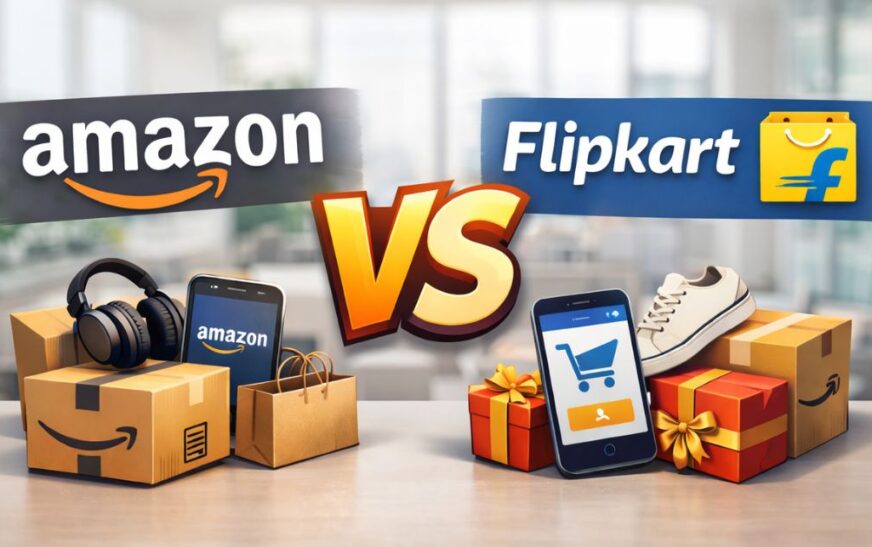
Flipkart vs Amazon India: Where Should You Buy Gadgets?
Most Indian gadget buyers check both platforms before purchasing. That’s the right instinct — but most stop at comparing the listed price and pick whichever is ₹50 cheaper.
The actual difference between Flipkart and Amazon India goes much deeper than the displayed price. Return windows, delivery reliability, counterfeit risk, payment offer stacking, and category-specific strengths all vary meaningfully between the two platforms. Buying on the wrong one for the wrong gadget category can cost you — in time, money, or both.
This guide breaks down every dimension that matters for gadget buyers in India, with a clear recommendation for each category.
Quick Verdict — By Gadget Category
| Category | Better Platform | Why |
|---|---|---|
| Budget smartphones (under ₹15K) | Flipkart | More aggressive discounts, wider budget selection |
| Flagship smartphones (₹30K+) | Amazon | Better authenticity track record, Prime delivery |
| Laptops | Amazon | Wider range, better seller quality, faster delivery |
| TVs | Tie | Similar pricing; choose based on delivery speed in your city |
| Earbuds & audio | Amazon | More premium brands, better return experience |
| Smart home devices | Amazon | Alexa ecosystem advantage, Amazon basics range |
| Kitchen appliances | Flipkart | More budget brands, better EMI options |
| Power banks & accessories | Flipkart | Budget segment stronger, more no-cost EMI options |
1. Pricing — Closer Than You Think
The honest answer: Flipkart and Amazon India price most gadgets within 2–5% of each other on any given day. For a ₹15,000 phone, that’s a ₹300–₹750 difference — real, but not the deciding factor.
Where the gap opens up:
- Flipkart tends to be cheaper on:
- Budget and mid-range smartphones (₹5,000–₹20,000 range)
- Fashion and accessories
- Products from Indian-origin brands (boAt, Noise, Realme, QUBO)
- Amazon tends to be cheaper on:
- Premium electronics (MacBooks, Sony headphones, Apple accessories)
- International brands with official Amazon storefronts
- Smart home devices (Amazon owns the Alexa ecosystem)
The most important pricing insight: The displayed price is rarely the final price. What actually determines the cost is the combination of platform discount + bank card offer + no-cost EMI + exchange value. Two identical phones listed at the same price can have a ₹3,000–₹5,000 difference in actual cost-to-buyer after applying all offers.
Before any gadget purchase above ₹5,000: Check PriceBaba.com, Smartprix.com, or 91mobiles.com for cross-platform price history. These tools show you if the “sale price” is genuinely discounted or just the regular price with a sale sticker.
2. Sale Events — Big Billion Days vs Great Indian Festival
Both platforms run their biggest sales simultaneously in September–October, and both genuinely offer significant discounts. The strategy of each is different.
Flipkart Big Billion Days:
- More aggressive upfront discounts — a phone listed at ₹69,990 drops to ₹51,999
- Better on budget and mid-range phones (Redmi, Realme, Motorola)
- ICICI and Axis Bank cards get 10% instant discount
- Flash deals that last a few hours with steeper cuts
Amazon Great Indian Festival:
- More conservative headline discounts, compensated with bundled value
- Better warranty extension offers, accessory bundles, and cashback
- SBI card 10% instant discount (most widely held Indian bank card)
- Slightly better on premium electronics (Apple, Sony, Samsung flagship)
The honest comparison: For a ₹15,000–₹30,000 smartphone purchase, Flipkart typically wins on headline discount. For a ₹50,000+ laptop or premium gadget, Amazon’s bundled offers and SBI discount often deliver comparable or better total value.
Strategic advice: Both sales now run simultaneously and last 5–7 days. Don’t panic-buy on Day 1. Prices on both platforms often drop further by Day 3–4 as sellers clear unsold inventory.
3. Returns & Refunds — Amazon Wins Clearly
This is the most practically important comparison for gadget buyers — and Amazon wins by a significant margin.
| Policy | Amazon India | Flipkart |
|---|---|---|
| Return window (electronics) | 10 days | 10 days |
| Return window (most products) | 30 days | 10 days |
| Refund processing | 5–7 business days | 5–7 business days |
| COD return refund | Bank transfer within 7 days | Same-night for morning returns |
| Return pickup | Reliable, scheduled | Variable — slower in Tier 2/3 cities |
| Customer satisfaction | Higher | Lower (1.8/5 on consumer review platforms) |
Amazon’s 30-day return window for most product categories is a significant advantage over Flipkart’s 10-day window. Electronics on both platforms get 10 days — but if you discover an issue on Day 12 with a router, laptop bag, or accessory, Amazon will still process the return where Flipkart won’t.
The practical reality for gadgets: Both platforms have 10-day return windows for electronics. The difference shows up in:
- Ease of initiating the return (Amazon’s process is simpler and more reliable)
- Return pickup speed (Amazon’s logistics partners are more consistent in metros)
- Dispute resolution (Amazon’s A-to-Z Guarantee provides escalation that Flipkart doesn’t match)
Flipkart’s one advantage: Cash-on-delivery return refunds are credited faster — if you return a COD order in the morning, Flipkart processes the refund the same evening. Amazon takes 3–5 days for COD refunds.
4. Delivery Speed — Depends Where You Live
In metro cities (Delhi, Mumbai, Bangalore, Hyderabad, Chennai): Amazon Prime delivers in 1–2 days consistently. Flipkart Plus matches this for products in Flipkart’s own warehouses, but third-party seller fulfilled orders are 1 day slower on average.
In Tier 2 cities (Jaipur, Lucknow, Chandigarh, Surat, Kochi): Largely comparable — both deliver in 2–3 days. Amazon has expanded fulfillment centers in these cities significantly.
In Tier 3 cities and smaller towns: Flipkart has a meaningful edge. Their Kirana store partnership network and regional warehouse expansion in 800+ smaller cities means more reliable delivery than Amazon, which still relies on third-party logistics in these areas.
Membership comparison:
| Feature | Amazon Prime (₹1,499/year) | Flipkart Plus (coins-based) |
|---|---|---|
| Fast delivery | ✅ Guaranteed 1-2 day in metros | ✅ Comparable in Tier 1-2 |
| Video streaming | Prime Video (large catalogue) | No |
| Music streaming | Prime Music | No |
| Early sale access | Yes | Yes |
| Value for money | Better for frequent buyers | Free tier adequate for most |
For buyers who shop online more than 8–10 times a year, Amazon Prime at ₹1,499/year pays for itself in delivery savings alone — and Prime Video is a genuine bonus.
5. Product Authenticity — Neither Platform Is Perfect
The uncomfortable truth: approximately 20–22% of products on both platforms have counterfeit-related complaints in independent surveys. Both Amazon and Flipkart are marketplace platforms with hundreds of thousands of third-party sellers — neither can guarantee authenticity across every listing.
What reduces your counterfeit risk on both platforms:
- Look for these markers:
- “Fulfilled by Amazon” (FBA): Amazon stores and ships the product — higher accountability than seller-shipped
- “Flipkart Assured”: Flipkart-verified seller with quality checks
- Official brand storefronts: Samsung Official Store, boAt Official Store, Xiaomi India Store — first-party sellers with brand accountability
Verify the official seller before buying big-ticket items: Most major brands publish their authorised seller lists on their official websites:
- Samsung India → samsung.com/in → Support → Where to Buy
- Xiaomi/Redmi → mi.com/in → Authorised retailers
- Apple India → apple.com/in → Authorised resellers
Red flags that apply on both platforms:
- Price more than 15% below every other listing for the same model
- Seller with fewer than 50 reviews or below 3.5 stars
- “Ships from China” on a product sold as Indian warranty
- Product description with grammatical errors or spec inconsistencies
6. Payment Strategy — How to Maximise Savings
The biggest savings on both platforms don’t come from the headline discount — they come from stacking offers. Here’s how to do it:
- Find the best headline price using PriceBaba or Smartprix
- Apply the right bank card:
- Flipkart: ICICI or Axis Bank card — 10% instant discount (max ₹5,000)
- Amazon: SBI card — 10% instant discount (max ₹5,000)
- Both: HDFC, Bajaj Finserv no-cost EMI widely available
- Check no-cost EMI:
- Available on both platforms for orders above ₹3,000
- Tenure options: 3, 6, 9, 12, 24 months
- Critical rule: No cashback applies when using EMI — choose EMI or cashback, not both
- Add exchange value:
- Both platforms offer instant exchange valuation at checkout
- For phones above ₹15,000, compare the exchange value on both platforms AND the brand’s official website — the highest trade-in value is often on the brand site, not the marketplace
Maximum savings example for a ₹25,000 phone purchase:
- Headline discount: ₹3,000 off (sale pricing)
- Bank card 10%: ₹2,200 off (on post-discount price)
- Exchange value (old phone): ₹5,000 off
- Total actual cost: ₹14,800 — 41% off the original price
This stacking strategy works on both platforms during major sales. The platform that gives you the highest combination of these four factors on the specific product you want wins for that purchase.
7. Customer Service — Amazon Has the Edge
Neither platform offers perfect customer service. Both have documented cases of delayed refunds, wrong item shipments, and difficult return processes. But the experience differs in meaningful ways.
Amazon’s advantages:
- 24/7 phone and chat support accessible without navigating multiple app menus
- A-to-Z Guarantee: If a seller fails to resolve your issue, Amazon steps in directly
- Generally higher resolution rate within the promised 48-hour window
Flipkart’s weaknesses:
- Support primarily through in-app chat (no easy phone escalation path)
- Account blocking for unclear reasons is a recurring complaint
- Return pickup scheduling is less reliable, especially outside metros
When neither platform resolves your issue: Both Amazon and Flipkart are subject to the Consumer Protection Act, 2019. File a complaint at:
- e-Daakhil portal (edaakhil.nic.in) — India’s official online consumer complaint portal
- National Consumer Helpline: 1800-11-4000
Platforms typically resolve disputes faster when a formal consumer complaint is filed — the legal escalation path is more effective than repeated customer service chats.
8. Category-by-Category Recommendation
Smartphones under ₹20,000: Flipkart — aggressive pricing on budget brands, better no-cost EMI options, stronger Big Billion Days deals on Redmi, Realme, Motorola.
Smartphones above ₹30,000: Amazon — better authenticity record for flagships, Prime delivery reliability, stronger A-to-Z protection for high-value purchases.
Laptops: Amazon — wider selection, more authorised seller storefronts, better return experience for high-value items.
Smart TVs: Check both — pricing is competitive within 1–3%. Decide based on which platform delivers faster to your city.
Audio (earbuds, headphones, speakers): Amazon for premium brands (Sony, Bose, JBL); Flipkart for Indian budget brands (boAt, Noise) during sales.
Smart home & accessories: Amazon — Alexa ecosystem advantage, Amazon Smart Home range, better international brand availability.
Kitchen appliances: Flipkart — stronger budget brand selection, more aggressive no-cost EMI tenures for appliances.
The Framework — How to Decide for Any Purchase
Check both prices using PriceBaba or Smartprix — note the difference
Check your bank card — which platform gives you the better instant discount?
Check the seller — is it an official brand store or third-party? Prefer official
Check the return window — for a high-value item, Amazon’s 30-day window may be worth a small price premium
Check delivery time — if you need it in 2 days, Amazon Prime wins in metros; Flipkart Plus wins in smaller cities
For items above ₹15,000 — always verify the official seller on the brand’s website before completing checkout
Frequently Asked Questions
Q: Is Amazon or Flipkart safer for buying a phone? Both carry similar counterfeit risk from third-party sellers. Buy only from official brand storefronts (Samsung Official Store, Xiaomi India Store, etc.) on either platform. Flipkart Assured and Fulfilled by Amazon listings are safer than standard third-party seller listings.
Q: Which platform is better during festival sales? Flipkart for budget phones (₹5,000–₹20,000). Amazon for premium electronics and Apple products. For everything else, compare both with all offers applied before deciding.
Q: Should I get Amazon Prime or Flipkart Plus? Amazon Prime at ₹1,499/year is the better value if you shop online frequently and live in a metro city — the Prime Video benefit alone is worth the subscription for most users. Flipkart Plus is free (earned through purchase coins) and adequate for occasional shoppers.
Q: Can I trust “No Cost EMI” offers on both platforms? Yes — no-cost EMI is legitimate. The seller/brand absorbs the interest cost, not the buyer. The catch: no instant cashback applies when you choose EMI. Calculate whether the full cashback or the 0% EMI saves you more on a specific purchase.
Our Verdict
There is no universal winner. Amazon is better for reliability, returns, and premium gadgets. Flipkart is better for budget phones, kitchen appliances, and festival sale discounts.
The smartest approach: bookmark both, use a price comparison tool before every purchase above ₹3,000, and choose based on the combination of price, payment offer, seller quality, and delivery speed — not platform loyalty.

Pooja Garg is a tech and lifestyle writer at Gadgistry.com, specializing in smartphones, smart home devices, and kitchen appliances. She focuses on simplifying product features into clear, practical insights to help readers make informed buying decisions.
Her work highlights real-world usability, value for money, and the latest trends in everyday technology, making it easier for readers to choose the right gadgets for their needs.