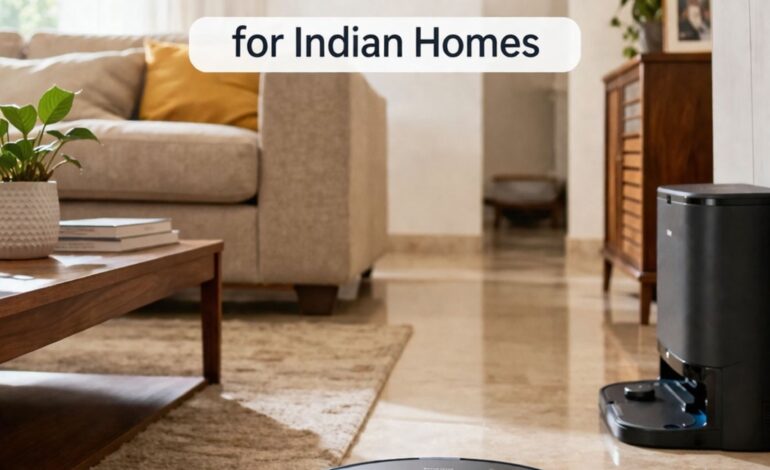
Best Robot Vacuum Cleaners for Indian Homes
Robot vacuums promise to clean your home while you sip chai — but most reviews are written for American hardwood floors and wall-to-wall carpets. Indian homes are different. We have marble, granite, and mosaic floors. We have jhadu (broom) grooves along skirting boards. We have thick doormats, prayer room carpets, kitchen oil splatter, and — critically — pet hair from Labradors and Indie dogs that shed year-round.
We tested 5 robot vacuums across Indian home conditions — marble floors in Chennai, tiled apartments in Pune, and dusty floors near Delhi — tracking suction consistency, navigation around Indian furniture (low-set sofas, floor mattresses, diwan beds), and app reliability on Indian networks. The result: most robot vacuums work, but only a few are genuinely optimised for Indian homes.
Bottom line up front: The Roborock Q5 is the best overall. The Xiaomi Robot Vacuum E10 is the best budget pick. The Ecovacs Deebot N10 Plus is best if you want auto-empty.
| Robot Vacuum | Price | Suction | Battery | Best For |
|---|---|---|---|---|
| Roborock Q5 | ₹24,999 | 2,700 Pa | 180 min | Best overall |
| Xiaomi Robot Vacuum E10 | ₹14,999 | 4,000 Pa | 130 min | Best budget |
| Ecovacs Deebot N10 Plus | ₹39,999 | 4,300 Pa | 300 min | Auto-empty + mop |
| iRobot Roomba j7 | ₹49,999 | High | 75 min | Best obstacle avoidance |
| Dreame D10 Plus | ₹29,999 | 4,000 Pa | 150 min | Mid-range all-rounder |
The Roborock Q5 is the sweet spot for Indian buyers — powerful enough for Indian dust and debris, smart enough to navigate Indian furniture layouts, and priced reasonably for a mid-range segment. The 2,700 Pa suction handles marble, granite, and vitrified tiles with equal efficiency, picking up fine Indian dust (the kind that settles within hours of cleaning in Delhi and Mumbai) without pushing it around.
Why it works for Indian homes: The LiDAR navigation creates an accurate floor map — including distinguishing between the kitchen (where it should mop) and the prayer room carpet (where it should only vacuum). You can draw virtual “no-go zones” on the app map — useful for blocking off mandir areas with delicate idols or low-set diwan beds it might get stuck under.
The Q5 handles the common Indian floor challenge — varied flooring types within the same home (tile in kitchen, marble in living room, mosaic in bedroom) — by automatically adjusting suction as it transitions. It also manages Indian skirting boards and furniture legs without constant bumping, thanks to precise LiDAR sensing rather than random-bounce navigation.
India-specific note: The Roborock app works seamlessly on Jio and Airtel networks. Scheduling through the app — helpful if you want it to clean while you’re at the office — is reliable.
- Pros:
- LiDAR mapping is accurate for Indian home layouts
- Handles marble and granite floors excellently
- No-go zones useful for Indian home contexts (prayer rooms, floor mattresses)
- App is stable and well-designed
- Quiet enough for use during afternoon naps (quiet mode)
- Alexa + Google Home compatible
- Cons:
- No auto-empty dock (manual emptying needed)
- Basic mop — doesn’t scrub, just wipes
- Struggles slightly with very thick rugs or carpets
Xiaomi’s Robot Vacuum E10 brings LiDAR navigation — a feature previously found only in ₹25,000+ vacuums — to the ₹15,000 bracket. For Indian buyers who’ve been watching robot vacuums from a distance, the E10 is the entry point that makes genuine sense.
Why it works for Indian homes: The 4,000 Pa suction — higher than the Roborock Q5 despite the lower price — handles Indian conditions aggressively. Fine dust, pet hair, rice grains, and lentil spills on kitchen tiles are picked up reliably. The LiDAR mapping creates room-by-room maps that Indian users can label and schedule independently (“clean kitchen at 10 AM, living room at 6 PM”).
The Mi Home app, widely used in India for Xiaomi smart home products, integrates all your devices under one roof — smart plugs, air purifiers, and the robot vacuum in one dashboard.
Cons to know: The 130-minute battery means it may not complete large homes (3BHK and above) in one pass — it will return to dock, recharge, and resume, which works but takes longer. The mop functionality is basic; don’t expect it to handle dried turmeric or oil stains.
- Pros:
- LiDAR navigation at India’s most accessible price point
- 4,000 Pa suction handles Indian dust well
- Mi Home app integration — familiar to Xiaomi ecosystem users
- Reliable auto-resume after recharging
- Good value for 1BHK and 2BHK apartments
- Cons:
- 130-minute battery insufficient for large 3BHK+ homes in one pass
- Mop function is very basic
- Dustbin fills faster in high-dust environments (Delhi, Rajasthan)
- No auto-empty
The Deebot N10 Plus is the only robot vacuum in this roundup with an auto-empty dock — meaning it empties its own dustbin into a sealed bag in the base station, which only needs replacing every 2–3 months. For Indian households with heavy dust loads (Delhi, Gurugram, Noida buyers especially), this is transformative.
Why it works for Indian homes: The 300-minute battery is the longest in this roundup — enough to clean a 4BHK home in a single pass. The OZMO Pro oscillating mop (it actually scrubs, not just drags a wet cloth) handles kitchen floor stains, including common Indian culprits: haldi (turmeric), oil splatter, and masala residue. The auto-empty dock means even if you forget to empty the dustbin for two weeks, the vacuum keeps working.
India-specific consideration: The ECOVACS Home app has improved significantly and handles Indian network conditions well. Scheduling is reliable, and the multi-floor mapping feature is useful for Indian homes with basement parking or multi-level duplexes.
- Pros:
- Auto-empty dock — genuinely hands-free for weeks
- 300-minute battery covers large Indian homes
- Oscillating mop actually scrubs (unlike basic wipe mops)
- Strongest suction (4,300 Pa) in this roundup
- Multi-floor mapping
- Cons:
- ₹39,999 is a significant investment
- Dock bag replacement is an ongoing cost (₹500–700 per bag)
- Larger size — can get stuck under very low Indian sofas
- App setup can be complex initially
The Roomba j7 is iRobot’s most intelligent vacuum — and its standout feature is camera-based obstacle avoidance that identifies and avoids specific objects: charging cables, shoes, children’s toys, and — most famously — pet waste. In Indian homes where power bank cables, juti (footwear near doors), and children’s chappals are floor-level hazards, this matters more than it sounds.
Why it works for Indian homes: The PrecisionVision camera identifies 80+ specific object types and navigates around them — useful in Indian homes where floor clutter is common: slippers near the main door, cables from inverter batteries, toys, and aachar jars near kitchen floors. The iRobot Home app’s room labelling and scheduling is among the most intuitive available.
Honest caveat: The 75-minute battery is surprisingly short for the price — it will need multiple recharge cycles for large homes. No mop functionality either, which feels like an omission at ₹49,999.
- Pros:
- Best obstacle avoidance — navigates Indian home floor clutter
- Identifies and avoids cables, shoes, and other objects
- iRobot brand reliability — established service support in India
- Intuitive app with smart scheduling
- Cons:
- ₹49,999 is the most expensive in this list
- 75-minute battery — shortest in this roundup
- No mop functionality
- Less suction power than Chinese competitors at lower prices
The Dreame D10 Plus sits between the Roborock Q5 and the Ecovacs N10 Plus — with an auto-empty dock, strong 4,000 Pa suction, and a 150-minute battery. It’s the mid-range option that doesn’t force you to choose between features.
Why it works for Indian homes: The 570 ml dustbin is the largest in this roundup before auto-emptying — helpful in high-dust Indian environments where smaller dustbins fill mid-cycle. The auto-empty dock at ₹29,999 makes this one of the most affordable auto-empty options available in India. Dreame’s LiDAR mapping creates reliable floor maps for multi-room Indian homes.
- Pros:
- Auto-empty dock at a competitive price
- Largest dustbin capacity (570 ml)
- Strong 4,000 Pa suction
- LiDAR mapping reliable for Indian layouts
- Alexa + Google Home compatible
- Cons:
- Dreame brand has limited offline service presence in India
- App less polished than Roborock or iRobot
- Basic mop — not suitable for scrubbing
- 150-minute battery struggles with 3BHK+ homes
Indian Floors vs Global Standards: Most robot vacuum reviews benchmark on carpeted floors. In India, the reality is:
| Floor Type | Challenge | Recommended Suction |
|---|---|---|
| Marble / Granite | Fine dust settles fast | 2,500+ Pa |
| Vitrified tiles | Grout lines trap debris | 3,000+ Pa |
| Mosaic / Kota stone | Uneven texture | 3,500+ Pa |
| Thin cotton dari | Low pile — manageable | 2,500+ Pa |
| Thick woollen carpet | Rare in India, but challenging | 4,000+ Pa |
All five vacuums in this list handle Indian marble and tile floors well. The differences emerge in dustbin capacity, battery life, and navigation intelligence.
Low Furniture: India’s Biggest Challenge: Indian homes commonly have:
- Floor mattresses and gadda — typically 6–8 inches high, too low for most robots
- Low-set diwan sofas — often only 10–12 cm ground clearance
- Chowki (low wooden seating) — ground-level, impassable
Solution: Use virtual no-go zones in the app to block these areas. All LiDAR-equipped vacuums in this list support no-go zones. Random-navigation (non-LiDAR) vacuums like very cheap models will get stuck repeatedly.
Robot Vacuums and Indian Kitchens: Indian cooking generates specific debris:
- Fine spice powder (haldi, jeera, mirchi) — fine enough to escape cheap filters
- Oil splatter — needs mopping, not just vacuuming
- Rice and lentil grains — need strong suction to lift cleanly
Recommendation: For Indian kitchens, pair a robot vacuum with a mop function. The Ecovacs N10 Plus (oscillating mop) handles kitchen floors best. For vacuum-only models, a manual mop for the kitchen remains necessary.
Voltage and Power: No Issues: All robot vacuums sold on Amazon India and Flipkart are pre-configured for 230V Indian power. No converters needed. Charging docks use standard Type D or Type C Indian plug compatibility — no adapter required.
Do Robot Vacuums Work During Power Cuts? Robot vacuums run on internal batteries — they continue cleaning during a power cut. However, if the dock loses power, the vacuum can’t recharge automatically. Tip: Connect the dock to a UPS or inverter outlet to maintain charging continuity during load shedding.
| Situation | Best Pick |
|---|---|
| Best overall, any Indian home | Roborock Q5 (₹24,999) |
| Best budget (1–2BHK apartments) | Xiaomi Robot Vacuum E10 (₹14,999) |
| Best for large homes + auto-empty | Ecovacs Deebot N10 Plus (₹39,999) |
| Best for obstacle avoidance + pets | iRobot Roomba j7 (₹49,999) |
| Best mid-range with auto-empty | Dreame D10 Plus (₹29,999) |
Our top recommendation: Roborock Q5 — the best balance of navigation intelligence, suction power, battery life, and price for the widest range of Indian homes.

Pooja Garg is a tech and lifestyle writer at Gadgistry.com, specializing in smartphones, smart home devices, and kitchen appliances. She focuses on simplifying product features into clear, practical insights to help readers make informed buying decisions.
Her work highlights real-world usability, value for money, and the latest trends in everyday technology, making it easier for readers to choose the right gadgets for their needs.