Grey Market vs Official: Should You Buy Grey Market Gadgets in India?
What Is the Grey Market in India?
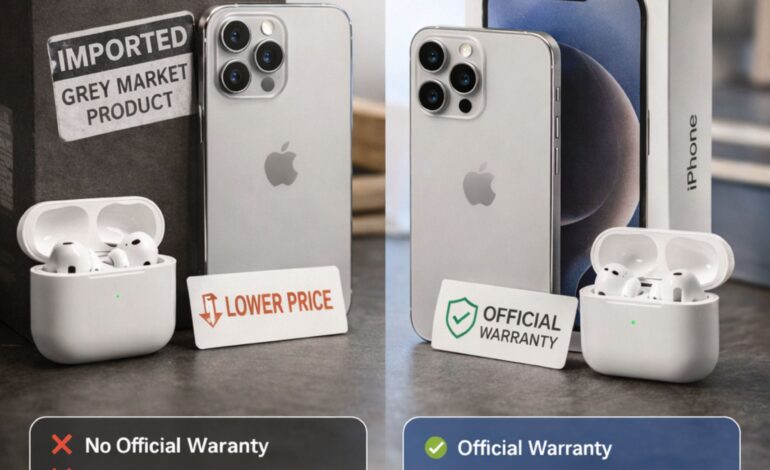
The grey market is not the black market. Grey market products are genuine, brand-new products — not fake, not stolen, not refurbished. The “grey” refers to the fact that they are imported and sold outside the official authorised distribution channel for India.
Here’s how it works:
- A brand launches a product in the UAE, Singapore, or Hong Kong at a lower price (due to lower import duties or different pricing strategy)
- An importer buys units in bulk from that market
- The importer brings them into India — paying customs duty or sometimes bypassing it
- The devices are sold through local shops, online sellers, or social media at prices below the official Indian MRP
What grey market is NOT:
- ❌ Fake or counterfeit products (those are black market)
- ❌ Stolen goods
- ❌ Refurbished or used products (separate category)
- ❌ Illegal to buy (buying is legal; avoiding customs duty during import is the legal grey area)
The Real Risks of Buying Grey Market Gadgets
1. No Indian Warranty — This Is the Biggest Risk
This is where most buyers get burned. Grey market devices come with either:
- No warranty at all, or
- International warranty that is not honoured in India
What this means in practice: If your grey market iPhone develops a battery issue at 11 months, Apple India will refuse service — because the device’s IMEI is not registered under the India distribution. You’ll pay out-of-pocket for repairs that would have been free under an official device.
| Brand | Grey Market Warranty Policy |
|---|---|
| Apple | No Indian warranty — IMEI flagged at any Apple Store India |
| Samsung | Checks IMEI — grey market devices get paid service only |
| Sony | No Indian warranty on parallel imports |
| Xiaomi | Some international models work; policy varies by device |
| OnePlus | India-specific software — international versions unsupported |
| Bose / JBL | No Indian warranty on grey market units |
2. Network Compatibility Issues
India uses specific 4G LTE and 5G bands — primarily Band 3, Band 5, Band 40, and Band 28 for 4G, and n78 and n28 for 5G. International devices sold in the US, Japan, or even Europe support different bands.
A phone “with 5G” from the US market may not support India’s n78 band — meaning you’ll get 4G at best on Jio or Airtel, despite paying for a 5G device. Always verify Indian band compatibility before buying any grey market phone.
Check this: Visit the brand’s official spec page and compare the device’s band support against your carrier’s Indian band list (Jio, Airtel, and Vi publish their band lists online).
3. No BIS Certification — Legal and Safety Concern
The Bureau of Indian Standards (BIS) certification is mandatory for all electronic devices sold officially in India. Grey market devices lack BIS certification — which means:
- They haven’t been tested for Indian voltage compliance (230V, 50Hz)
- Chargers may not meet Indian safety standards
- In theory, selling uncertified electronics is illegal (buying is not)
For most devices, this is a minor concern — modern electronics are largely universal. But for chargers, power banks, and devices with high power draw, uncertified hardware poses a genuine safety risk.
4. Software and OTA Update Issues
Some brands lock regional software to the market of sale:
- OnePlus India models run OxygenOS India — international models run a different software branch and may miss India-specific features and updates
- Xiaomi global models work in India, but MIUI China versions (sometimes sold as grey market) are Chinese-language firmware and require flashing
- Samsung international models sometimes miss India-specific features (Samsung Pay UPI, regional language support)
Always ask which software version the device runs and whether it receives OTA updates in India.
5. IMEI Verification and the CEIR Database
India’s Central Equipment Identity Register (CEIR) — run by the Department of Telecommunications — is a national database of all IMEIs. Grey market phones that haven’t gone through official customs may have IMEIs that are flagged, duplicated, or not registered in India. The government has the authority to block non-registered IMEIs on Indian networks.
How to check: Before buying any grey market phone, ask the seller for the IMEI. Verify it on the CEIR portal (ceir.gov.in) to confirm it’s a valid, unblocked device.
When Grey Market Can Make Sense
1. Accessories and Non-Repairable Items
For products where warranty doesn’t matter much — cables, cases, screen protectors, basic earphones — grey market pricing is a legitimate saving. If a ₹300 cable fails, you buy another. The warranty risk is irrelevant.
2. Products with Global Warranties
Some brands honour international warranties globally:
- GoPro — global warranty, service in India available
- DJI drones — DJI Care Refresh covers India regardless of purchase region
- Garmin — global warranty policy (verify per product)
For these brands, the grey market price advantage is genuine with minimal risk.
3. Discontinued or Unavailable Products
If a specific product is not officially launched in India — a camera model, a niche audio device — grey market is sometimes the only channel. In this case, you’re buying with full knowledge of the warranty gap.
4. When You Have Reliable Repair Access
Tech-savvy buyers in cities like Delhi, Mumbai, and Bengaluru with access to reliable third-party repair shops sometimes buy grey market intentionally — knowing they’ll handle repairs independently. This is a calculated risk, not a recommendation for everyone.
When to Absolutely Avoid the Grey Market
1. Smartphones — High Risk
Smartphones are the worst grey market purchase for most buyers. The combination of warranty voids, potential network band incompatibility, software issues, and IMEI risks makes the savings rarely worth it. Stick to official channels for any smartphone purchase.
2. Laptops — Very High Risk
Laptops have expensive repair costs. A grey market laptop with a failed display, dead battery, or motherboard issue will cost you more in repairs than the initial savings. Additionally, Microsoft Windows licenses and brand support portals often tie to regional purchase records.
3. Medical-Grade Wearables
If you’re using an Apple Watch for ECG monitoring or a fitness band for health condition management, buy official. Sensor calibration and software health features are often region-locked.
4. Large Appliances and Televisions
230V compatibility is generally fine, but service networks for refrigerators, ACs, and televisions are tied to official distributors. A grey market Samsung TV in a Tier 2 city may have no service support within 100 km.
How to Spot a Grey Market Product Before Buying
- Step 1: Check the box language. Official India products print “For Sale in India Only” and include the BIS certification mark on the box. International boxes are in English only without Indian regulatory markings, or in another language entirely.
- Step 2: Verify the IMEI (for phones). Dial *#06# on the device or check Settings → About Phone. Run the IMEI on ceir.gov.in to verify it’s registered and unblocked in India.
- Step 3: Check the charger plug type. India uses Type D (round 3-pin) and Type C plugs. International chargers come with Type A (US flat-pin) or Type G (UK 3-pin). A Type A charger in the box is a reliable indicator of a non-India model.
- Step 4: Check warranty registration. Attempt to register the product on the brand’s India warranty portal. If it rejects the serial number, it’s a grey market unit.
- Step 5: Ask the seller directly. A legitimate grey market seller will acknowledge the product’s origin. If a seller claims it’s “official India stock” but the price is 20%+ below MRP, that’s a red flag.
Where Grey Market Products Are Sold in India
Physical markets:
- Delhi: Nehru Place, Gaffar Market (Karol Bagh)
- Mumbai: Manish Market (Crawford Market area)
- Chennai: Ritchie Street
- Bengaluru: SP Road
- Hyderabad: Abids
Online channels:
- WhatsApp-based sellers (common for iPhones and Sony products)
- OLX and Quikr listings (often misrepresented as official stock)
- Some third-party Amazon/Flipkart sellers (read seller details carefully)
Red flags on Amazon/Flipkart: If the seller is not the brand itself or a clearly official distributor, and the price is significantly below the official listing, verify carefully. Marketplace seller grey market products are common.
The Official Alternative: How to Get Good Prices Legitimately
You don’t always need to risk grey market to get good prices:
- Bank card offers: HDFC, SBI, ICICI, and Axis regularly offer 10–15% instant discounts on electronics
- Sale events: Big Billion Days (Flipkart) and Great Indian Festival (Amazon) offer 20–30% discounts on official stock with full warranty
- Exchange offers: Trading in an old device can offset ₹5,000–20,000 on a new purchase
- EMI no-cost offers: 0% EMI on credit cards effectively gives you time-value savings
- Refurbished official: Amazon Renewed and Flipkart 2GUD offer certified refurbished products with 6-month warranty
Frequently Asked Questions
Q: Is buying grey market products illegal in India? Buying grey market products as a consumer is legal. The legal grey area applies to the importer who may have avoided customs duty. As a buyer, you face no legal risk — only warranty and support risks.
Q: Can grey market iPhones be activated in India? Yes — grey market iPhones can be activated and used in India. They work on Indian networks (assuming band compatibility). The risk is warranty: Apple India will not service them under warranty.
Q: Will grey market phones get software updates in India? Generally yes, for most global brands. iOS updates are global. Android updates from Samsung, Xiaomi global versions, and OnePlus international builds receive updates — but may lag behind or miss India-specific features.
Q: How much cheaper is the grey market really? Savings range from 8–30% depending on the product. iPhones typically save 10–18%. Sony and Bose headphones 15–25%. Budget Android phones — very little saving, rarely worth the risk.
Q: What happens if my grey market phone gets blocked by CEIR? A CEIR-blocked IMEI means your phone cannot connect to any Indian mobile network. You’ll have Wi-Fi but no cellular service. This is a real risk with grey market phones that bypassed official customs.
Final Verdict: Grey Market Buying Decision Framework
- Is it a smartphone or laptop? Avoid grey market
- Does the brand offer global warranty? Consider grey market
- Is it an accessory or cable? Grey market is fine
- Does it need Indian network bands? Verify bands first
- Is the saving more than 15%? Acceptable risk
- Can you verify the IMEI on CEIR? Proceed carefully
Short answer: Grey market makes sense for accessories, globally warranted products, and unavailable items. For smartphones, laptops, and large appliances — buy official, wait for a sale, use bank offers, and sleep better.

Pooja Garg is a tech and lifestyle writer at Gadgistry.com, specializing in smartphones, smart home devices, and kitchen appliances. She focuses on simplifying product features into clear, practical insights to help readers make informed buying decisions.
Her work highlights real-world usability, value for money, and the latest trends in everyday technology, making it easier for readers to choose the right gadgets for their needs.