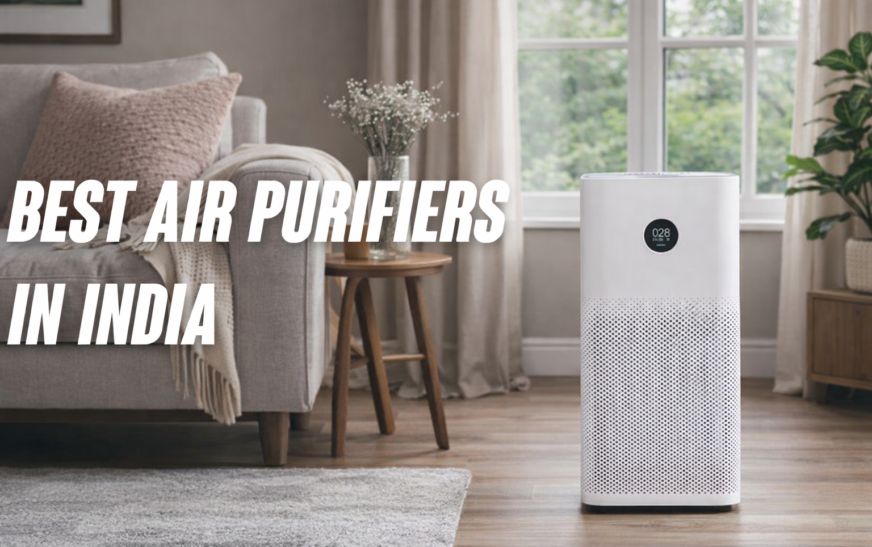
Best Air Purifiers for Indian Homes (2026) – Tested for AQI
1. CADR Rating (Not Room Size Claims)
CADR (Clean Air Delivery Rate) measures how much filtered air a purifier delivers per hour in cubic metres (m³/h). It’s the most honest performance metric — and most brands bury it.
- Single room / 1BHK: 150–300 sq ft needs 150–220 m³/h CADR
- 2BHK living room: 300–450 sq ft needs 220–330 m³/h CADR
- 2BHK full coverage: 650–800 sq ft needs 330–450 m³/h CADR
- 3BHK living + kitchen: 900–1,100 sq ft needs 450–550 m³/h CADR
When a brand says “covers 500 sq ft,” check the CADR. If it’s below 300 m³/h, that coverage claim is optimistic.
2. True HEPA H13 — Not “HEPA-Type” or “HEPA-Style”
True HEPA H13 filters capture 99.95% of particles down to 0.3 microns — including PM2.5, which is 2.5 microns and smaller. H11 HEPA captures 95% at the same particle size. H13 is what you need for serious Indian pollution.
“HEPA-type,” “HEPA-style,” or “HEPA-like” filters are marketing terms with no certification standard. They may capture 80–90% of particles — not enough when PM2.5 levels are 11x above safe limits.
Always look for H13 certification on the filter itself, not just the product listing.
3. Annual Filter Cost — The Hidden Expense
A ₹6,000 purifier with ₹3,000 filters replaced every 6 months costs ₹6,000/year to run. A ₹14,000 purifier with ₹2,490 filters replaced once a year costs ₹2,490/year. Long-term ownership cost inverts the initial price comparison.
Check filter price and replacement frequency before buying. Factor it into your 3-year total cost.
| Use Case | Best Pick | Price |
|---|---|---|
| Best Overall | Honeywell Air Touch V4 | ₹7,999 |
| Best for Delhi / High AQI Cities | Honeywell Air Touch i11 | ₹14,000–₹16,000 |
| Best for 1BHK / Single Room | Levoit Core Mini | ₹4,490–₹4,999 |
| Best Long-Term Value | Coway AirMega 150 | ₹14,000–₹15,000 |
| Best Smart / App-Controlled | Qubo Q500 | ₹8,500–₹9,500 |
| Best Budget Pick | Qubo Q200 | ₹4,500–₹4,999 |
| Best for Large 3BHK | Honeywell Air Touch U2 | ₹18,000–₹20,000 |
The Honeywell Air Touch V4 hits the sweet spot for most Indian 2BHK homes — 300 m³/h CADR, 5-stage H13 HEPA filtration, a real-time AQI display, and quiet 22dB operation at the lowest speed. For a bedroom or a mid-sized living room in a city with moderate to high pollution, it covers everything without overspending.
The Coway AirMega 150 is the air purifier to buy if you’re thinking beyond year one. Its filter lasts 8,500 hours — roughly 14–18 months at 16 hours/day operation — which is the longest filter lifespan in this price category by a significant margin. Replacement filters cost ₹2,490 and are widely available online.
If you live in Delhi, Gurgaon, Noida, Faridabad, or any NCR city — or if your AQI regularly exceeds 150 — the Honeywell Air Touch i11 is the minimum recommendation. Its 500 m³/h CADR handles rooms up to 600 sq ft and cleans the air in a standard Delhi 2BHK living room fast enough to make a meaningful difference during pollution peaks.
The Qubo Q500 is India’s most connected air purifier at this price — built by Hero MotoCorp’s smart home brand, it integrates with Alexa, Google Home, and the Qubo app for real-time AQI monitoring, remote scheduling, and usage tracking. If you already use smart home devices, the Q500 fits seamlessly.
For a single room — a bedroom, study, or baby’s room — the Levoit Core Mini is the most recommended compact purifier in India. Under 3 kg, under ₹5,000, with H13 HEPA filtration and 25dB near-silent operation. It won’t cover a full flat, but for one room it’s the right size and the right price.
The Qubo Q200 is the only budget air purifier under ₹5,000 in India that includes both H13 HEPA filtration and app-based AQI monitoring. For buyers who want smart connectivity without crossing ₹5,000, it’s the only realistic option in this segment.
| City | Typical AQI | Pollution Level | Minimum CADR |
|---|---|---|---|
| Delhi / NCR | 150–210 | Severe | 450–500 m³/h |
| Kanpur / Lucknow | 130–180 | Very High | 350–450 m³/h |
| Mumbai | 80–120 | Moderate | 250–300 m³/h |
| Bangalore | 90–120 | Moderate | 220–300 m³/h |
| Chennai | 90–110 | Moderate | 220–280 m³/h |
| Hyderabad / Pune | 90–130 | Moderate | 250–300 m³/h |
| Kolkata | 120–160 | High | 300–400 m³/h |
For Delhi buyers specifically: Do not buy a purifier with less than 350 m³/h CADR for any room you spend significant time in. During peak pollution months (October–January), lower-CADR purifiers will run at maximum speed continuously — generating noise, consuming electricity, and still failing to bring indoor PM2.5 to safe levels in larger rooms.
This is the most important safety warning in this article.
Ozone generators are being sold on Amazon India and Flipkart as “air purifiers” — often at attractive ₹2,000–₹4,000 price points. They are not air purifiers. They are harmful devices that generate ozone gas, which at high concentrations damages lung tissue, aggravates asthma, and creates secondary toxic compounds (including formaldehyde) when it reacts with household chemicals.
How to spot an ozone generator on a listing:
- Description mentions “ozone” or “O₃” as a cleaning method
- Claims to “kill bacteria and viruses” without mentioning HEPA filtration
- Price is unusually low for the coverage area claimed
- No CADR rating mentioned anywhere in the listing
The EPA and California Air Resources Board both recommend against ozone generator use in occupied spaces. If you’ve already bought one — stop using it in occupied rooms.
Stick to HEPA H13 filtration. It’s the only technology proven safe and effective for Indian PM2.5 levels.
Concern about electricity bills is one of the most common reasons Indian buyers delay buying an air purifier. Here’s the actual math:
| Model | Power Draw | Hours/Day | Monthly Cost* |
|---|---|---|---|
| Levoit Core Mini | ~28W | 8 hrs | ~₹45 |
| Honeywell V4 (auto mode) | ~35W avg | 16 hrs | ~₹90 |
| Qubo Q500 | ~40W avg | 16 hrs | ~₹105 |
| Honeywell i11 (auto mode) | ~50W avg | 16 hrs | ~₹130 |
*Based on ₹8/unit average Indian electricity tariff
Running a mid-range air purifier 16 hours a day costs roughly ₹90–₹130/month — less than a single restaurant meal. The auto mode on sensor-equipped models is key: when indoor AQI is good, the purifier drops to its lowest fan speed, reducing electricity consumption significantly.
Continuous operation on auto mode is more effective than switching it on only when pollution is visible. Particulate matter is invisible — you can’t see PM2.5. Auto mode adjusts fan speed based on real-time air quality, keeping electricity consumption low when the air is already clean.
No — air purifiers work within a defined coverage area. You need either multiple units or a high-CADR single unit placed centrally in the room where you spend most time. The kitchen generates significant VOCs and particulates during cooking — a separate unit there is worthwhile if you cook daily.
Every 6–18 months depending on your city’s pollution level and daily usage hours. Delhi buyers at 16 hours/day should plan for annual replacement. Bangalore and Mumbai buyers using 8–10 hours/day may get 18 months per filter. Most purifiers have a filter indicator light — follow it rather than a fixed schedule.
Yes for Indian homes — particularly for cooking odours, VOCs from paints and furniture, and gas-phase pollutants that HEPA filters don’t capture. All recommended models in this list include activated carbon alongside HEPA.
No. Air purifiers filter particulate matter and gases — they do not trap or kill insects. You need a separate mosquito repellent solution for that.
For most Indian 2BHK homes, the Honeywell Air Touch V4 at ₹7,999 is the best starting point — it covers the right room size, has a real-time AQI sensor, runs quietly, and the washable pre-filter extends main filter life.
If you live in Delhi or any city with AQI regularly above 150, step up to the Honeywell Air Touch i11 — the higher CADR makes a measurable difference when pollution peaks in winter.
For buyers who want the lowest 5-year total cost of ownership, the Coway AirMega 150 wins on filter life (8,500 hours), replacement cost (₹2,490), and the industry’s best 7-year warranty.
And if your budget is firm at ₹5,000 for a single room, the Levoit Core Mini is the cleanest, quietest option available.
Whatever you buy — make sure it says H13 HEPA on the filter, and avoid anything that mentions ozone.
Pooja Garg is a tech and lifestyle writer at Gadgistry.com, specializing in smartphones, smart home devices, and kitchen appliances. She focuses on simplifying product features into clear, practical insights to help readers make informed buying decisions.
Her work highlights real-world usability, value for money, and the latest trends in everyday technology, making it easier for readers to choose the right gadgets for their needs.